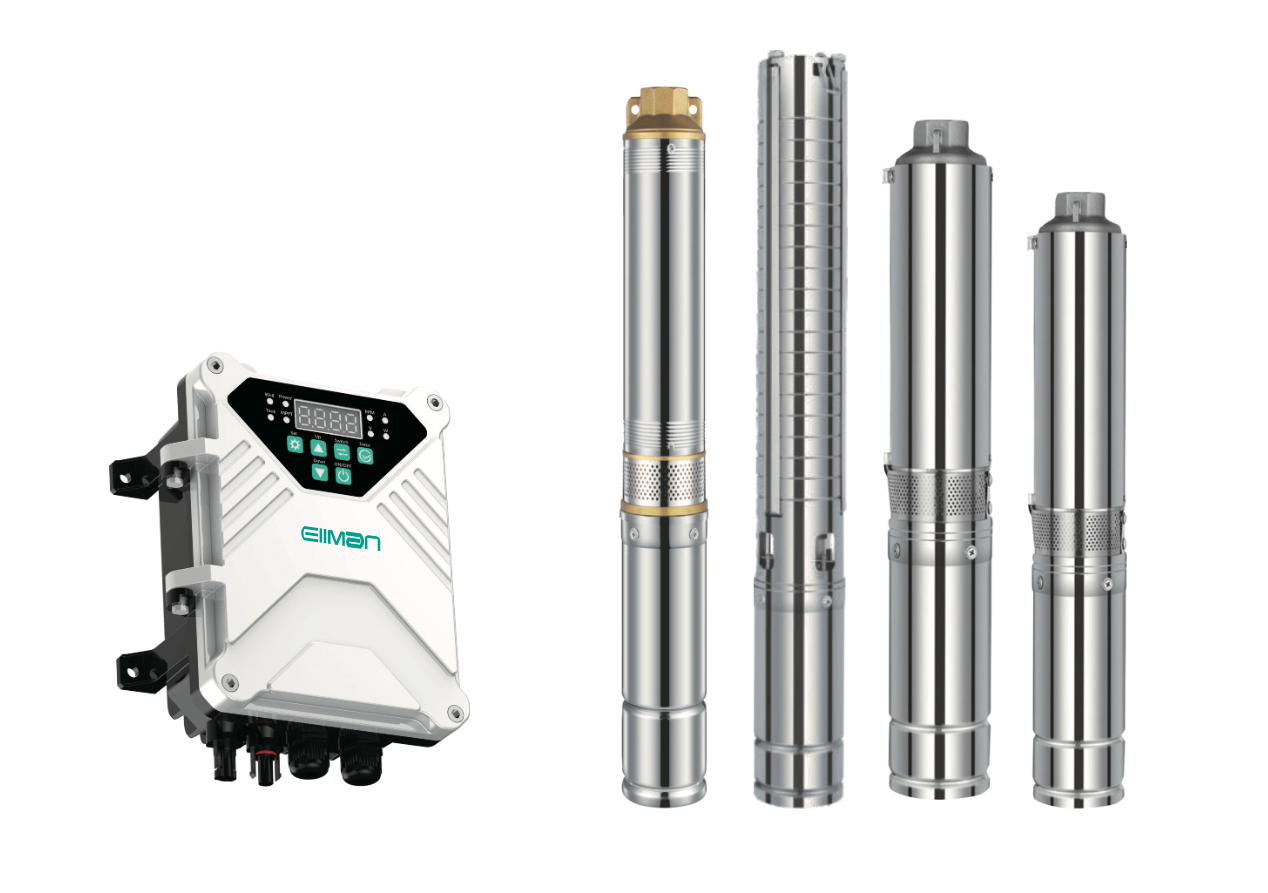
In solar deep well pumping systems, motor control technology directly determines efficiency, reliability, and long-term performance.
Many manufacturers still use traditional six-step BLDC control. At Eiiman Pump, we have chosen advanced Sinusoidal (FOC – Field Oriented Control) technology instead.
Here is why.
1. Understanding the Difference: BLDC vs. Sinusoidal Control
Although both BLDC and sinusoidal systems use permanent magnet motors, their control methods are fundamentally different.
BLDC (Six-Step Control)
- Trapezoidal back-EMF
- Square-wave current commutation
- Discrete 120° switching
- Simpler and lower-cost control
Sinusoidal Control (FOC)
- Sinusoidal current waveform
- Continuous magnetic field rotation
- Precise torque regulation
- Advanced current vector control
In simple terms:
BLDC approximates a rotating magnetic field.
Sinusoidal control precisely constructs it.
2. Why This Matters for Solar Deep Well Pumps
Solar deep well systems operate under demanding conditions:
- High starting torque (deep water column pressure)
- Long daily operating hours
- Fluctuating solar input voltage
- Limited cooling capacity underground
- Off-grid reliability requirements
Under these conditions, control precision becomes critical.
3. Startup Performance: Smooth vs. Abrupt
Deep well pumps require strong and stable starting torque.
BLDC Control:
- Current changes abruptly during commutation
- Higher torque ripple
- Larger startup current spikes
- Greater stress on inverter and solar system
Eiiman Sinusoidal Control:
- Smooth current ramp-up
- Controlled soft-start
- Stable low-speed torque output
- Reduced stress on MPPT and power electronics
Result:
- Reliable startup even in low sunlight
- Reduced mechanical wear
- Longer pump lifespan
4. Efficiency Comparison: More Water per Watt
Solar pumping systems depend entirely on energy utilization efficiency.
BLDC square-wave current introduces:
- Harmonic losses
- Increased copper heating
- Additional electromagnetic vibration
Sinusoidal control reduces harmonic distortion and optimizes current alignment with the rotor magnetic field.
The practical impact:
- Higher motor efficiency
- Lower heat generation
- Increased water output under the same solar input
For agricultural and remote water supply systems, this directly translates to productivity gains.
5. Thermal Performance in Deep Wells
Deep well environments limit heat dissipation.
BLDC torque ripple and harmonic currents increase motor heating over long operation periods.
Eiiman sinusoidal control provides:
- Reduced torque ripple
- Lower stator heating
- Improved long-term insulation protection
This is critical for pumps operating 6–20 hours daily.
6. Performance Under Solar Voltage Fluctuation
Solar energy is inherently unstable:
- Cloud movement
- Temperature shifts
- Panel angle variation
BLDC control is less adaptive to voltage fluctuation at low speeds.
Eiiman sinusoidal control integrates seamlessly with MPPT systems, enabling:
- Wide voltage operating range
- Stable torque under low irradiation
- Extended daily operating window
More runtime = more total water pumped per day.
7. Cost vs. Value
BLDC control offers lower initial cost due to simpler electronics.
Sinusoidal control requires:
- Advanced microcontrollers
- Accurate current sensing
- Sophisticated algorithms
However, for solar deep well applications, long-term benefits outweigh the incremental cost:
- Higher efficiency
- Lower maintenance risk
- Reduced overheating
- Improved reliability
- Longer service life
In remote or agricultural environments, reliability is more valuable than marginal upfront savings.
8. Eiiman’s Engineering Philosophy
At Eiiman Pump, we prioritize:
Efficiency
Reliability
Durability
Our adoption of sinusoidal (FOC) motor control reflects our commitment to delivering professional-grade solar deep well pumping solutions.
For solar systems where every watt matters and every day of operation counts, precision control makes the difference.
Conclusion
When comparing Sinusoidal Control vs. BLDC for solar deep well pumps:
- Sinusoidal control offers smoother startup
- Higher efficiency
- Lower thermal stress
- Better adaptation to solar fluctuation
- Superior long-term reliability
That is why Eiiman solar deep well pumps are built with advanced sinusoidal control technology.
Because in solar pumping, performance is not just about moving water — it is about maximizing energy, protecting equipment, and ensuring dependable operation for years.


Leave a Reply