
Solar panel selection should be based on voltage and power requirements.
Basic parameters of solar panels include: open-circuit voltage (Voc), operating voltage (Vmp), and maximum power (Pmax).
When panels are connected in series, the voltage increases; when connected in parallel, the current increases.
Example:
For a 48V 700W deep well pump, how should the solar panels be selected?
Assume available panels are 36V 200W.
How many panels are needed, and how should they be connected?
By default, the 36V 200W specification refers to the panel’s operating voltage and maximum power. The open-circuit voltage is typically about 10–20V higher than the operating voltage (refer to the actual label on each panel for exact values).
First, ensure the voltage meets the requirement.
The open-circuit voltage must not exceed the specified limit, otherwise it may cause irreversible damage.
Also, the DC controller must never be connected to AC power.
Before connecting the solar panels, it is recommended to measure the voltage. If it exceeds 210V, it must not be connected to the controller.
Since 36V operating voltage cannot meet the 48V requirement, based on the principle that voltage increases in series, you should first connect two panels in series.
This will give a voltage of 72V, and a total power of 200 × 2 = 400W.
Next, ensure the power meets the requirement.
The current power is 400W, so you need to add another identical group in parallel, resulting in 400 × 2 = 800W.
There is no need to worry about excessive power, as the controller will automatically limit it.
However, note that when adding in parallel, you must connect another full series group (two panels) in parallel.
Do not connect a single panel in parallel to an existing series string, as mismatched voltage may damage the panels.
The final configuration is as follows.
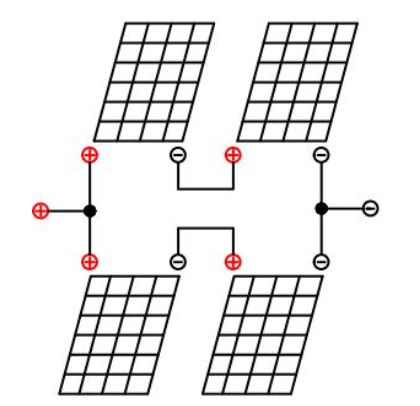
Tips: When connecting solar panels in parallel, both sides must have the same number of panels; otherwise, it may damage the solar panels.


Leave a Reply